
EasyReal supplied an experimental Pilot UHT/HTST Plant for Japan TH R&D Center located in Shanghai, China. The system was designed for laboratory-scale and pilot-scale research of various fluid food products, helping the customer carry out formulation development, sterilization testing, aseptic filling trials, and small-batch process validation.
The project was completed in March 2023 and configured with a Pilot Tubular Sterilizer, Aseptic Filling Cabinet, and supporting Utility System. This pilot production line provides the R&D team with a flexible platform to test different recipes, evaluate heat treatment parameters, and simulate industrial UHT or HTST production conditions before scaling up to commercial production.
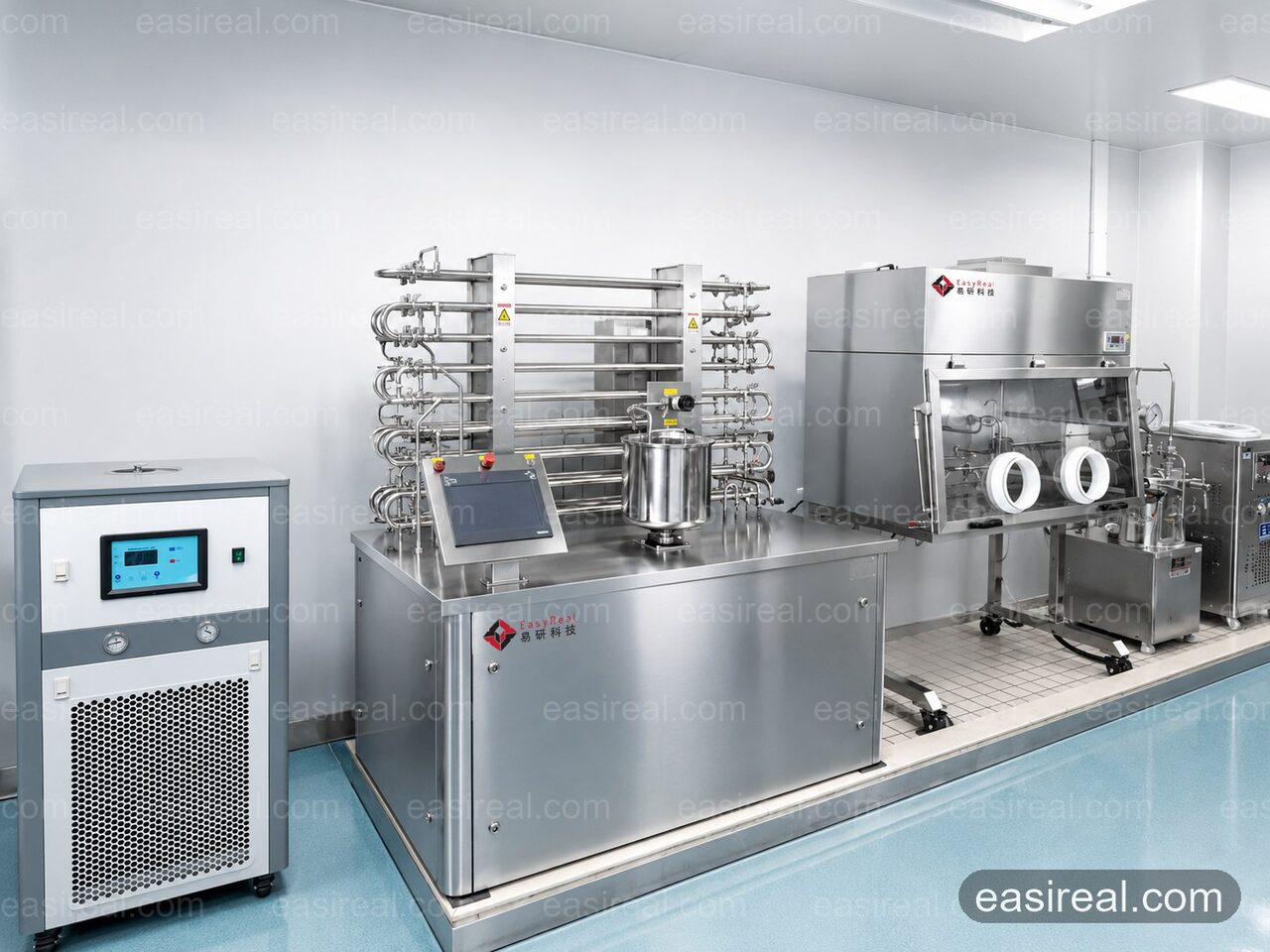
As a research and development center, the customer required a compact but complete pilot processing line for fluid food experiments. Unlike a single laboratory testing device, the system needed to cover the key process steps of thermal treatment and aseptic packaging, allowing the team to verify product stability, taste, texture, and process feasibility under controlled conditions.
The main application of this pilot UHT/HTST line is to support the development of different fluid food formulations, including dairy-based products, plant-based drinks, protein beverages, juice drinks, tea beverages, and other heat-sensitive liquid food products. For an R&D center, the equipment must be flexible, easy to operate, and suitable for repeated trials with different product types.
EasyReal provided a complete experimental UHT/HTST system based on the customer's R&D needs. The solution included a pilot tubular sterilizer for thermal processing, an aseptic filling cabinet for sterile packaging tests, and utility units to support stable operation.
The pilot line enables the customer to test both UHT and HTST processing concepts. By adjusting sterilization temperature, holding time, flow rate, and cooling conditions, the R&D team can compare the impact of different heat treatment processes on product quality and shelf-life performance.
This type of pilot system is especially useful before building a larger production line. It allows the customer to reduce formulation risk, optimize processing parameters, and collect practical data for future industrial-scale production.
Pilot Tubular Sterilizer
The pilot tubular sterilizer is the core unit of the system. It is used for controlled heating, holding, and cooling of fluid food products. Compared with plate-type heat exchangers, tubular sterilizers are suitable for a wider range of liquid products, including products with higher viscosity or small particles, depending on the final formulation and process design.
For R&D use, the tubular sterilizer helps engineers study how product characteristics change under different heat treatment conditions. The system can be used to evaluate product stability, flavor retention, color change, protein reaction, viscosity performance, and microbial safety targets.
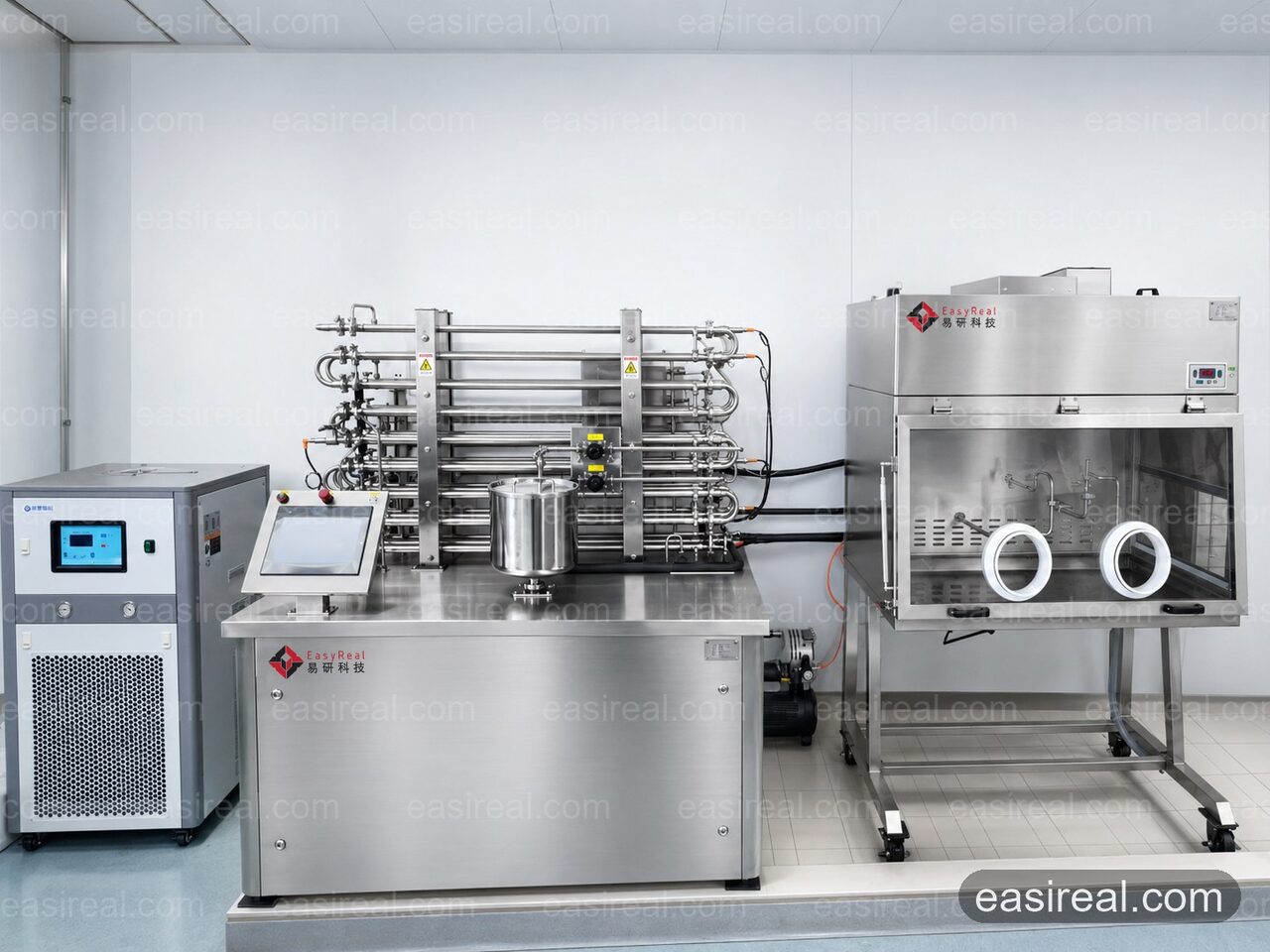
Aseptic Filling Cabinet
The aseptic filling cabinet allows the customer to perform sterile filling tests after UHT or HTST treatment. This is an important step for R&D projects because sterilization performance cannot be fully evaluated without a proper aseptic filling environment.
With the aseptic filling cabinet, the customer can collect product samples under cleaner and more controlled conditions. These samples can then be used for shelf-life observation, laboratory testing, packaging comparison, sensory evaluation, and internal formulation review.
Utility System
The utility system supports the operation of the pilot plant and helps maintain stable experimental conditions. For pilot-scale food processing, reliable utilities are essential because even small fluctuations in temperature, pressure, or flow can affect test results.
By integrating the sterilizer, filling cabinet, and utilities into one pilot solution, EasyReal helped the customer build a practical R&D platform rather than a simple standalone machine.
This pilot UHT/HTST plant can be used for the research and development of multiple fluid food categories, such as milk and dairy beverages, plant-based drinks, protein drinks, juice and fruit beverage formulations, tea and coffee beverages, neutral and low-acid liquid foods, functional drinks, nutritional beverages, and small-batch trial products before industrial production.
For food companies and R&D centers, this type of pilot system is valuable because it allows technical teams to move from laboratory formulation to real process simulation. A recipe that performs well in a beaker may behave differently during heating, cooling, and filling. Pilot processing helps identify these problems earlier.
UHT and HTST processes are widely used in the liquid food industry, but the correct parameters depend on product composition. Protein content, fat content, sugar level, stabilizer system, acidity, viscosity, and particle condition can all influence processing performance.
Some beverages may suffer from sedimentation, protein denaturation, cooked flavor, color darkening, or viscosity change after heat treatment. Without pilot testing, these problems may only appear after expensive industrial trials.
A pilot UHT/HTST plant gives the R&D team a controlled environment to test different processing conditions before scaling up. This helps reduce production risk, shorten development cycles, and improve the success rate of new product launches.
The EasyReal pilot UHT/HTST plant provides several practical benefits for Japan TH R&D Center in Shanghai.
First, it supports flexible product testing. The customer can run different fluid food recipes on the same platform and compare their processing behavior.
Second, it helps evaluate sterilization and filling performance together. This is important because thermal treatment and aseptic packaging must work as one complete process.
Third, the system is suitable for repeated experimental work. R&D teams often need to adjust formulas, process parameters, and sample batches many times before confirming the final production plan.
Finally, the pilot system helps bridge the gap between laboratory testing and industrial production. The data collected from pilot trials can provide a useful reference for future scale-up projects.
This project reflects EasyReal's capability in designing and supplying pilot-scale food processing systems for international R&D customers. For companies developing new fluid food products, pilot equipment is not only a testing tool but also an important decision-making platform.
By using a pilot UHT/HTST line, customers can test product feasibility, optimize formulas, verify sterilization conditions, and prepare for future commercial production with greater confidence.
EasyReal continues to provide customized pilot plants, laboratory-scale UHT systems, aseptic filling solutions, and complete fluid food processing lines for customers in dairy, beverage, plant-based food, fruit processing, and functional drink industries.
The Pilot UHT/HTST Plant for Japan TH R&D Center in Shanghai, China was designed to support experimental production, formulation development, and aseptic processing validation for various fluid food products. Equipped with a pilot tubular sterilizer, aseptic filling cabinet, and utility system, the line provides the customer with a flexible and practical platform for R&D testing.
For food manufacturers, universities, laboratories, and R&D centers looking to develop new liquid food products, EasyReal can provide customized pilot UHT/HTST solutions based on product characteristics, testing goals, and future scale-up requirements.
What is a pilot UHT/HTST plant used for?
A pilot UHT/HTST plant is used for small-batch testing, formulation development, sterilization trials, and process validation of liquid food products before industrial-scale production.
What products can be tested on this pilot line?
The system can be used for many fluid food products, including dairy beverages, plant-based drinks, protein drinks, juice beverages, tea drinks, coffee drinks, and functional liquid foods.
Why use a tubular sterilizer for pilot testing?
A tubular sterilizer is suitable for a wide range of liquid food products and can help R&D teams evaluate heat treatment performance, product stability, and process feasibility under controlled conditions.
Why is aseptic filling important in a pilot UHT line?
Aseptic filling allows sterilized products to be collected under cleaner and more controlled conditions, which is important for shelf-life testing, microbial evaluation, and packaging validation.
Can EasyReal customize pilot UHT/HTST systems?
Yes. EasyReal can customize pilot UHT/HTST systems according to product type, testing purpose, process requirements, and future scale-up plans.
Post time: Apr-03-2023