
In September 2022, EasyReal supplied a 1 ton per hour tomato paste production line for GIC SA in Niger. The project was designed for processing 200L and 220L aseptic bag tomato paste into ready-to-sell tomato paste products packed in 400g and 2.2kg tin cans.
The complete production line includes tomato paste unloading, blending and cooking, tubular sterilization, tin can filling, can seaming, spray pasteurization and cooling, as well as supporting utility systems such as CIP cleaning, purified water preparation and compressed air supply.
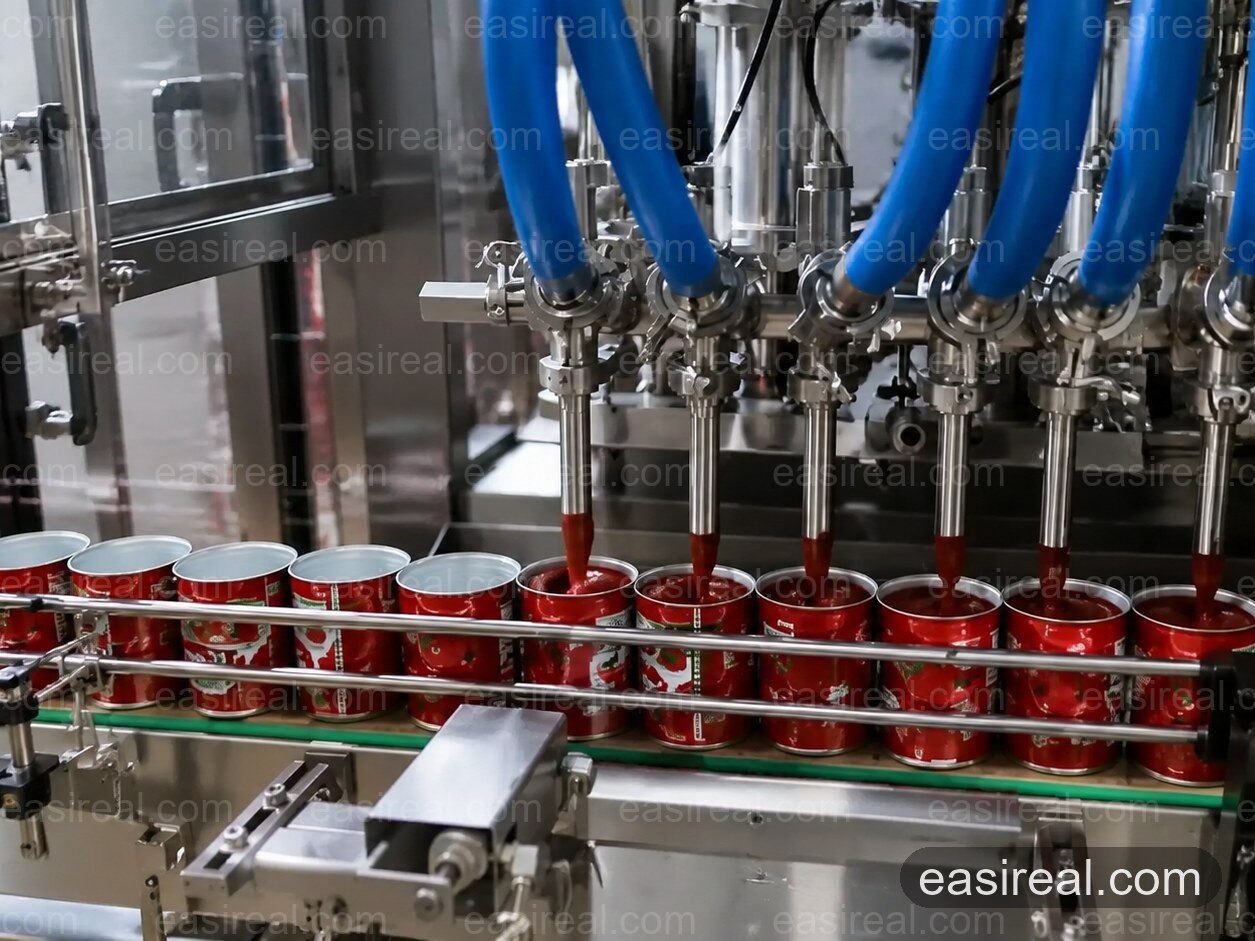
This project provides a practical solution for tomato paste manufacturers who need a compact, reliable and hygienic production line for medium-scale canned tomato paste production.
| Project Name | Tomato Paste Production Line with Output Capacity of 1 Ton per Hour |
|---|---|
| Client | GIC SA |
| Country | Niger |
| Project Time | September 2022 |
| Product | Tomato Paste in Tin Cans |
| Package Format | 400g and 2.2kg Tin Cans |
| Raw Material | 200L and 220L Aseptic Bag Tomato Paste |
| Storage Condition | Room Temperature Storage |
| Shelf Life | 1 Year |
The raw material used in this project is concentrated tomato paste packed in 200L and 220L aseptic bags. This type of raw material is commonly used in tomato paste reprocessing factories because it allows stable storage, convenient transportation and flexible production planning.
After unloading and dilution, the tomato paste is blended, heated, sterilized and filled into tin cans. The final products are suitable for room temperature storage with a shelf life of up to one year, depending on formulation, sterilization parameters, packaging quality and storage conditions.
The production line supports two common tin can formats: 400g tin cans for retail and household consumption, and 2.2kg tin cans for food service, catering and commercial users.
The line was designed with a processing capacity of approximately 1000L per hour, corresponding to an output capacity of around 1 ton per hour for tomato paste production.
This capacity is suitable for regional tomato paste brands, food processing companies and factories that need a stable canning solution without building a very large industrial plant.
The tomato paste production process mainly includes the following steps: Aseptic Bag Unloading → Suction Transfer → Dilution and Blending → Cooking and Standardization → Tubular Sterilization → Tin Can Filling → Can Seaming → Spray Pasteurization and Cooling → Drying / Coding / Packing.
Each section is designed to maintain product hygiene, reduce manual operation and ensure stable product quality.
Tomato Paste Suction System
The suction system transfers tomato paste from 200L or 220L aseptic bags into the production line. Since tomato paste has relatively high viscosity, the unloading system must provide stable transfer performance and reduce product residue.
The system helps improve feeding efficiency and keeps the production process cleaner compared with manual unloading.
Blending and Cooking System
The blending and cooking system is used for dilution, formulation adjustment and heating. According to the product recipe, water, salt, sugar, seasoning or other ingredients can be added during this stage.
The system helps achieve uniform product texture, stable Brix value and consistent taste before sterilization and filling.
Automatic Tubular Sterilizer
The automatic tubular sterilizer is one of the core systems of the production line. It is suitable for tomato paste and other medium-to-high viscosity products.
Compared with plate-type heat exchangers, tubular sterilizers are more suitable for products with higher viscosity, pulp content or thicker texture. The system provides stable heat treatment to improve product safety and extend shelf life.
Tin Can Filling Machine
The tin can filling machine is designed for accurate filling of tomato paste into 400g and 2.2kg tin cans. The filling system needs to handle viscous paste products while maintaining filling accuracy and clean operation.
Stable filling performance helps reduce product waste, improve packaging consistency and support continuous production.
Tin Can Seaming Machine
After filling, the cans are sealed by the tin can seaming machine. A reliable seaming process is critical for canned tomato paste because it directly affects sealing quality, shelf life and storage safety.
The seaming machine is designed to work continuously with the filling machine to maintain production efficiency.
Spray Pasteurization and Cooling Tunnel
After filling and sealing, the cans enter the spray pasteurization and cooling tunnel. This system provides additional heat treatment and controlled cooling for the packed products.
The spray tunnel helps stabilize final product quality, reduce microbial risk and prepare the cans for drying, coding and carton packing.
CIP Cleaning System
The CIP cleaning system is used for automatic cleaning of pipelines, tanks, heat exchangers and other product-contact parts. For tomato paste processing, CIP is especially important because the product is viscous and can easily remain inside pipelines or equipment surfaces.
A proper CIP system helps reduce manual cleaning workload, improve hygiene and shorten cleaning time between production batches.
Purified Water Preparation System
The purified water system provides process water for dilution, cleaning and utility use. Stable water quality is important for tomato paste reprocessing, especially when the formulation requires dilution.
Compressed Air System
The compressed air system supports pneumatic valves, filling equipment and other automatic control components. A stable air supply helps ensure smooth operation of the whole production line.
Tomato paste has a thicker texture than juice or low-viscosity beverages. During heat treatment, the product requires stable flow, uniform heating and reliable temperature control.
A tubular sterilizer is suitable for tomato paste because it can better handle viscous products, reduce blockage risk and provide strong processing stability. This makes it a practical choice for canned tomato paste production lines.
For canned tomato paste production, hygiene control is essential. EasyReal designs tomato paste processing lines with stainless steel product-contact parts, sanitary pipelines, automatic valves and CIP-compatible structures.
The full line is designed to support continuous production while helping the factory maintain food safety, cleaning efficiency and product consistency.
The final tomato paste products are packed in 400g and 2.2kg tin cans. After filling, seaming, pasteurization and cooling, the products can be stored at room temperature.
The designed shelf life is one year, subject to actual recipe, sterilization process, can quality, sealing performance and local storage environment.
For this project in Niger, EasyReal received customer-recorded site video materials after the production line was installed and operated locally. The videos showed the basic running condition of the tomato paste canning line, including product handling, filling and downstream processing.
Although the site material was recorded by the customer, it provides useful feedback on the actual operation of the tomato paste production line in Niger.
This tomato paste production line is suitable for tomato paste reprocessing factories, canned tomato paste manufacturers, food brands producing retail tomato paste, catering-size tomato paste production, regional food processing plants, and factories using aseptic bag tomato paste as raw material.
The line can also be customized according to different can sizes, filling capacity, product viscosity, recipe requirements and factory layout.
EasyReal provides complete tomato paste processing and canning solutions, covering process design, equipment manufacturing, automation control and production line integration.
For tomato paste manufacturers, EasyReal can provide customized solutions based on raw material type, product viscosity, target capacity, package format and shelf-life requirements.
From aseptic bag tomato paste unloading to final tin can packaging, EasyReal helps customers build efficient, hygienic and practical tomato paste production lines for commercial production.
The GIC SA tomato paste production line in Niger is a representative project for medium-scale canned tomato paste production. With a capacity of 1 ton per hour, the line processes 200L and 220L aseptic bag tomato paste and fills the final product into 400g and 2.2kg tin cans.
By integrating suction transfer, blending and cooking, tubular sterilization, tin can filling, seaming, spray pasteurization and CIP cleaning, the production line provides a complete solution for tomato paste manufacturers who need stable production, hygienic operation and room-temperature storage products.
Post time: Jan-01-2023