
When dairy and juice manufacturers request an automatic tubular or direct steam injection (DSI) UHT sterilization system, inline homogenization is often included in the required process. Customers may then question two items in the quotation: In-line Homogenization Modification & Control Cabinet for Homogenizer and Aseptic Water Generation System.
These are not optional accessories added to a standard homogenizer. For aseptic downstream inline homogenization, they are essential parts of the complete sterilization and homogenization system.
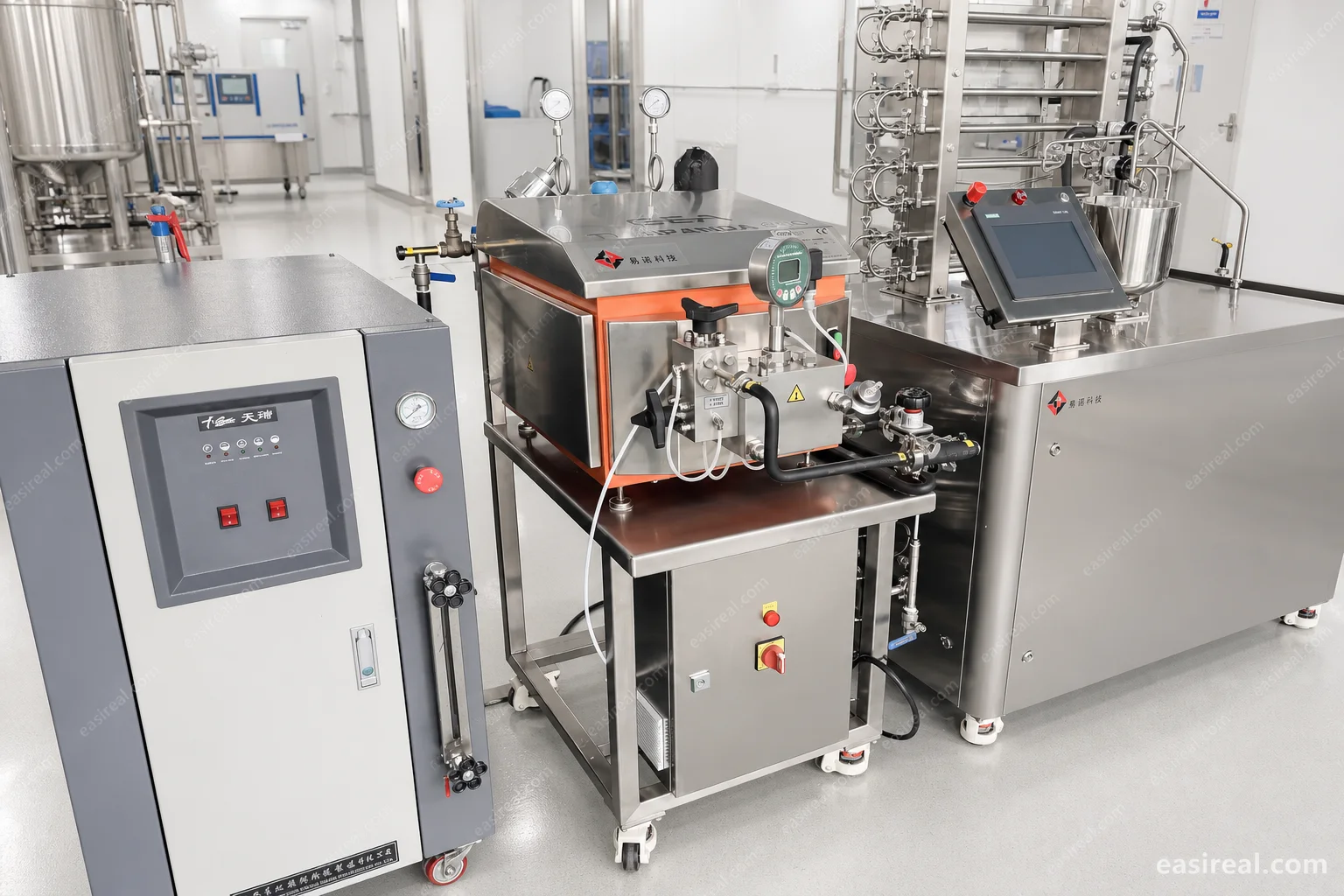
In a downstream arrangement, the product passes through its validated UHT sterilization stage before entering the homogenizer. A typical sequence is product preparation → preheating → UHT sterilization → holding → aseptic downstream homogenization → final cooling → aseptic storage or filling.
At the homogenizer inlet, the product is already commercially sterile. Every subsequent product-contact component must preserve that aseptic condition. This is fundamentally different from upstream homogenization, where the final thermal treatment occurs after homogenization.
Downstream service therefore requires a homogenizer suitable for aseptic duty and properly integrated into the UHT process—not merely a standard standalone machine placed after the sterilizer.
Hygienic mechanical integration
The homogenizer becomes part of the continuous sterile product circuit. Its sanitary connections, product piping, valves, dampers, drainability and pressure rating must match the tubular or DSI sterilizer. The installation must also support the required CIP and SIP sequences without creating dead legs or unprotected interfaces.
Flow synchronization
A standalone homogenizer has its own rated capacity, but an inline homogenizer must follow the actual sterilizer flow. A mismatch can cause unstable inlet pressure, excessive backpressure, cavitation or interruption of the validated thermal process. A frequency inverter, pressure sensors and coordinated control logic are normally required to keep the two machines synchronized.
Pressure coordination and protection
A high-pressure homogenizer is also a positive-displacement pump. It directly affects the pressure before and after the machine. The integrated design may therefore include inlet- and discharge-pressure monitoring, product-flow measurement, relief protection, alarm limits and automatic shutdown or diversion logic.
One coordinated operating sequence
The homogenizer must exchange signals with the UHT system during water circulation, production, product changeover, CIP, SIP and fault conditions. It should not enter aseptic production if sterilization has not been completed or if a critical utility is unavailable.
The quotation item In-line Homogenization Modification & Control Cabinet for Homogenizer represents the engineering required to make a suitable homogenizer operate as one coordinated system with the sterilizer. Depending on the application, this can include:
- hygienic inlet and outlet modifications;
- pressure-rated sanitary piping and aseptic components;
- a frequency-controlled drive;
- pressure and flow instrumentation;
- PLC and HMI integration;
- production, CIP and SIP sequences;
- alarm, interlock and emergency-stop logic; and
- signal exchange with the UHT sterilizer.
The control cabinet is therefore not simply an on/off panel. It is the automation interface that enables the homogenizer and sterilizer to work safely as one continuous processing line.
High-pressure homogenizers use rapidly reciprocating plungers. Water is commonly required around the plunger and seal area for lubrication, temperature control or barrier duty, depending on the machine design.
When the homogenizer is downstream of UHT sterilization, these moving seals form a critical boundary between the sterile product zone and the surrounding environment. Ordinary utility water can introduce a microbiological risk at this interface, particularly during seal wear, pressure changes or abnormal operation.
The Aseptic Water Generation System supplies controlled sterile water to the relevant plunger, seal or valve-seat chambers. The water supports cooling and lubrication while maintaining an aseptic barrier that reduces the risk of recontamination. In normal operation, this barrier water is not intended to mix directly with the product.
Main functions of the aseptic water system
- sterilize incoming water using controlled temperature and holding conditions;
- cool it to the required operating temperature without losing hygienic status;
- maintain the required sterile-water flow during production;
- monitor critical temperature, pressure and flow conditions;
- issue alarms or stop aseptic production if the barrier is lost; and
- participate in the coordinated CIP and SIP sequence.
The homogenizer modification and control cabinet solve the mechanical, hydraulic and automation integration requirements. The aseptic water system protects the critical moving interfaces after sterilization. Installing only one of them leaves the downstream process incomplete.
Reliable aseptic downstream inline homogenization therefore requires both a properly modified and controlled aseptic homogenizer and a validated, monitored aseptic-water supply.
Not necessarily. An upstream homogenizer operates before final sterilization, so a standard hygienic inline configuration may be sufficient when it meets the product and process requirements. A downstream homogenizer operates after sterilization and belongs to the aseptic zone; it therefore requires the aseptic design and barrier arrangement specified for that machine.
Downstream homogenization is common in direct UHT or DSI processing and may also be selected in indirect tubular UHT systems for high-fat, high-protein, emulsion or other sensitive formulations.
- Will homogenization be upstream or downstream of sterilization?
- Is the UHT system tubular, plate-type, DSI or steam-infusion based?
- What are the required flow rate, homogenization pressure and product characteristics?
- Is the selected homogenizer designed for aseptic downstream duty?
- What sterile-water or condensate-barrier arrangement does its manufacturer require?
- How will flow, pressure, CIP, SIP and fault conditions be coordinated?
- Which conditions must trigger product diversion or production shutdown?
Aseptic downstream inline homogenization cannot be achieved by simply connecting a standard homogenizer after a UHT sterilizer. It requires hygienic mechanical modification, synchronized flow and pressure control, integrated production/CIP/SIP logic, and a monitored aseptic water system for the homogenizer's critical plunger and seal interfaces.
The In-line Homogenization Modification & Control Cabinet makes the homogenizer operate correctly as part of the sterilization line. The Aseptic Water Generation System helps preserve the sterile condition already established by UHT treatment. Both are essential engineering components of a reliable downstream aseptic process.
EasyReal provides customized automatic tubular HTST/UHT sterilization systems, DSI processing systems, laboratory and pilot UHT/HTST lines, inline homogenizer integration and supporting aseptic utilities for dairy, juice and other fluid-food applications. Contact EasyReal to discuss the correct process configuration for your product.
Post time: Aug-13-2026