
China — March 2024 — Shanghai EasyReal Machinery Co., Ltd. supplied a Pilot UHT/HTST Plant for Yili Dairy in China. This pilot-scale system is designed for dairy product trials, thermal process validation, and formulation development, helping the customer carry out product research in a more flexible, controlled, and production-relevant way.
The system includes a Pilot Tubular Sterilizer, Inline Homogenizer, Aseptic Filling Cabinet, and related utility modules. It is built to support R&D work for different dairy products and to provide a practical bridge between laboratory testing and industrial production.
A pilot UHT/HTST plant is especially valuable for dairy companies because product behavior can change greatly when heat treatment, pressure, homogenization, and filling conditions change. Bench testing alone is often not enough. A pilot system allows the customer to test real process logic on a small scale before moving to larger production equipment.
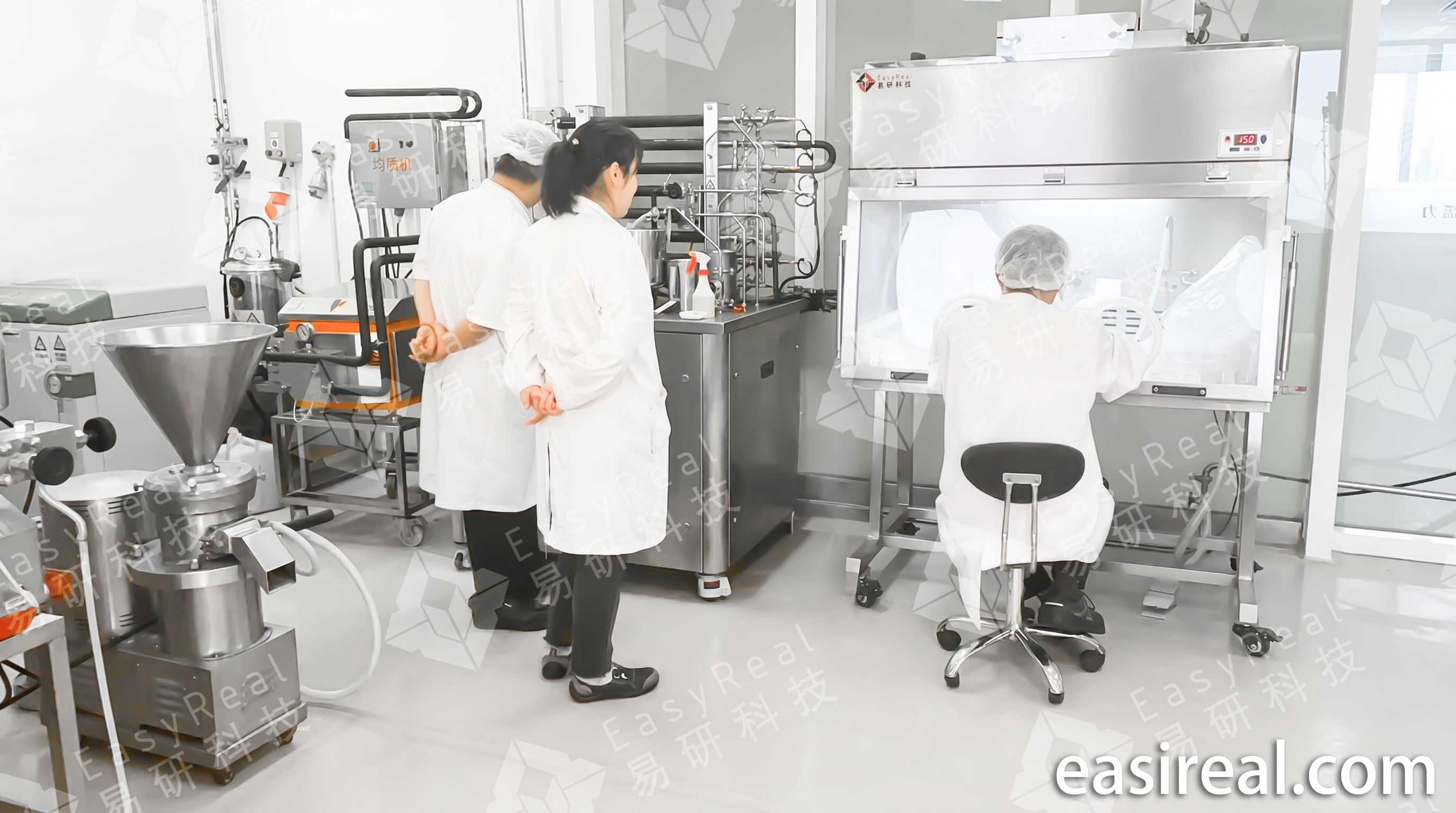
Customer: Yili Dairy
Country: China
Project year: March 2024
Project type: Pilot UHT/HTST Plant
Main purpose: dairy experimentation and formulation development
Main modules:
• Pilot Tubular Sterilizer
• Inline Homogenizer
• Aseptic Filling Cabinet
• Utility modules
This project was designed for dairy R&D work where precision, repeatability, and flexibility are all important.
Dairy product development is not only about creating a formula in a lab. It is also about understanding how that formula behaves during real processing.
A dairy product may look good in a small beaker test, but its performance can change after:
• heating
• holding
• homogenization
• pumping
• aseptic filling
That is why a Pilot UHT/HTST Plant is an important development tool. It helps the customer evaluate both product formulation and process performance at the same time.
With a pilot plant, a dairy company can:
• test different heat treatment conditions
• compare UHT and HTST results
• evaluate stability after homogenization
• prepare real trial samples
• support internal R&D decisions
• reduce scale-up risk
• improve development efficiency
For a large dairy company, this kind of pilot system is not just a machine. It is a core part of the innovation workflow.
This project is mainly used for all kinds of dairy experiments and formulation development. That means the system can support pilot-scale work on a wide range of dairy liquid products and development tasks.
The plant allows the customer to carry out:
• thermal treatment trials under controlled conditions
• product formula comparison
• homogenization effect evaluation
• pilot batch preparation
• aseptic sample collection
• process parameter optimization
• stability observation after treatment
• preparation for future production scale-up
This makes the system suitable for real R&D work rather than only simple laboratory heating tests.
The Pilot Tubular Sterilizer is the core thermal processing section of the project. It allows the customer to test both UHT and HTST process routes under pilot conditions.
In dairy development, thermal treatment affects many important product features, including:
• microbiological safety
• flavor retention
• protein behavior
• viscosity
• color stability
• product shelf life potential
By using a pilot tubular sterilizer, the customer can study how different dairy formulas respond to heat and adjust the process accordingly.
This is very important because dairy products are often sensitive to treatment conditions. A good pilot thermal section helps create more reliable R&D conclusions.
The Inline Homogenizer is another key part of this pilot plant. In dairy processing, homogenization plays an important role in product texture and stability.
It can help improve:
• mouthfeel
• emulsion uniformity
• particle size distribution
• physical stability
• visual consistency
For dairy products, the effect of homogenization is often closely linked with heat treatment. A formula may behave differently depending on the processing sequence and pressure conditions. That is why having an inline homogenizer in a pilot system adds strong value to product development work.
This module helps the customer test and compare different dairy product behaviors under realistic pilot conditions.
The Aseptic Filling Cabinet is used for controlled filling of trial batches after processing. This is a very important step in pilot testing because it allows the customer to collect product samples in a cleaner and more process-relevant way.
The aseptic filling section supports:
• pilot sample collection
• storage testing
• formulation comparison
• shelf life observation
• packaging-related evaluation in R&D work
For dairy development, trial samples must often be observed over time. That means the filling step should match the hygienic level required for meaningful product evaluation. The aseptic filling cabinet helps create that condition.
The pilot plant also includes the required utility modules for stable operation. Utilities are not always the most visible part of a project, but they are essential for accurate and repeatable testing.
Stable utilities support:
• thermal process control
• system consistency
• repeatable trial conditions
• reliable equipment performance
A good pilot system must not only have key process units. It must also integrate them into one coordinated platform. This project is built in that way, with sterilization, homogenization, filling, and utilities working together as one functional pilot plant.
For Yili Dairy, this pilot plant provides a practical internal platform for product innovation and technical validation.
The main value of the system includes:
1. Faster formulation development
The R&D team can test dairy formulas more efficiently under pilot conditions.
2. Better process understanding
The customer can study the interaction between heating, homogenization, and filling in one system.
3. Lower development risk
Pilot testing helps reduce uncertainty before industrial production or scale-up trials.
4. Better sample preparation
The aseptic filling cabinet supports more useful and more controlled sample collection.
5. Stronger product consistency decisions
The system helps compare different process settings and identify more suitable development routes.
For a dairy company with continuous product development needs, a pilot UHT/HTST plant is a long-term strategic tool.
Compared with simple lab-scale equipment, a pilot system like this offers several important advantages.
More realistic processing logic
The product passes through real process steps instead of isolated single-point testing.
Better scale-up relevance
Results from pilot tests are more useful when preparing industrial production plans.
More flexible testing
The customer can adjust process conditions during development and compare results more efficiently.
More valuable technical data
The R&D team can observe product response under heat and pressure conditions that are closer to real manufacturing.
Better support for innovation
A good pilot platform helps shorten the path from idea to validated product concept.
These are exactly the reasons why pilot plants are increasingly important in modern dairy R&D.
Post time: Nov-03-2024