
China — Commissioning completed on August 1, 2022 — Shanghai EasyReal Machinery Co., Ltd. supplied a Pilot UHT/HTST Plant for TING HSIN INTERNATIONAL GROUP (Master Kong) in China. This pilot-scale system is mainly used for tea beverage trials, fluid food experiments, and formulation development.
The system is equipped with a Pilot Tubular Sterilizer, Inline Homogenizer, Aseptic Filling Cabinet, and related utility modules. It provides the customer with a practical pilot platform for thermal testing, process evaluation, recipe optimization, and aseptic sample preparation.
For beverage and liquid food R&D, pilot-scale equipment plays a very important role. It allows the customer to study product performance under realistic process conditions before moving to larger-scale production. This is especially valuable when working with tea drinks and other fluid foods where flavor, appearance, stability, and heat response all matter.
Customer: TING HSIN INTERNATIONAL GROUP (Master Kong)
Country: China
Project type: Pilot UHT/HTST Plant
Main application: tea beverage and fluid food R&D
Main modules:
• Pilot Tubular Sterilizer
• Inline Homogenizer
• Aseptic Filling Cabinet
• Utilities
Commissioning completed: August 1, 2022
This project was built for pilot-scale product testing and process development, where control accuracy, flexibility, and repeatability are all essential.
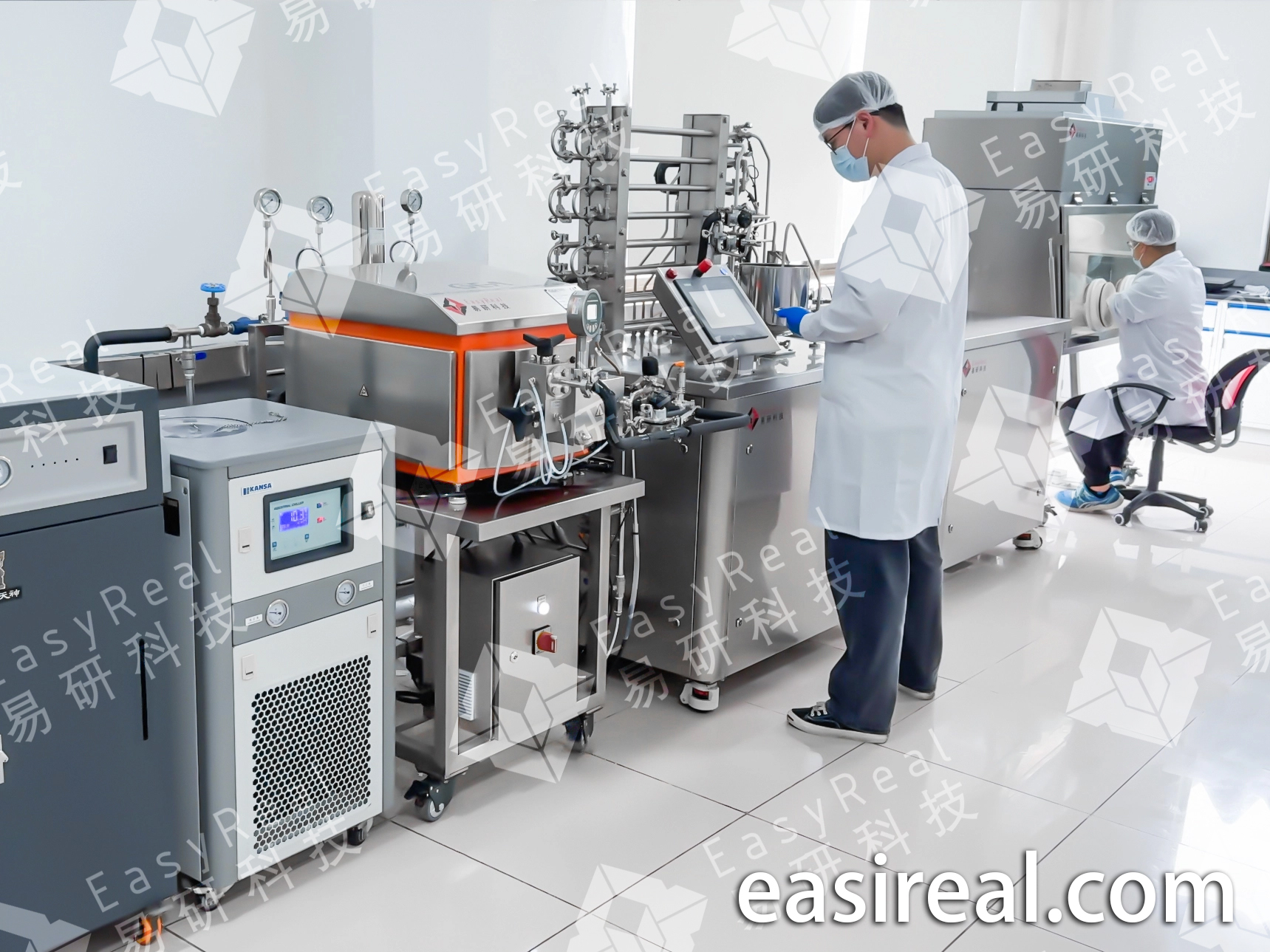
This pilot UHT/HTST plant is mainly used for all kinds of tea beverages and other fluid food experiments and formulation development.
For a large food and beverage group, pilot testing is not only about preparing samples. It is also about verifying process conditions, comparing formulas, reducing development risk, and improving technical understanding before industrial production. A pilot plant makes R&D work much closer to real manufacturing conditions.
This kind of system is especially useful for:
• tea drink formulation trials
• heat treatment comparison
• process validation
• pilot sample preparation
• scale-up study
• product stability evaluation
For tea beverages, even small process differences can influence flavor, color, sediment behavior, and final product stability. That is why pilot-scale testing is much more meaningful than simple bench-scale trials alone.
Tea drinks and other fluid foods often require careful control of thermal treatment and product handling. If the process is not suitable, the final product may show changes in:
• taste
• aroma
• color
• turbidity
• texture
• storage performance
A pilot UHT/HTST plant helps the customer understand how the product behaves during continuous processing. It supports better decision-making in formulation development and allows R&D teams to work with more reliable pilot data.
This is important for:
• new product development
• process optimization
• recipe adjustment
• pre-scale-up validation
For companies developing tea beverages, pilot processing helps connect R&D ideas with real production logic.
The Pilot Tubular Sterilizer is the core thermal processing unit of this project. It allows the customer to carry out pilot-scale UHT and HTST trials under controlled conditions.
Thermal treatment is one of the most important steps in tea beverage processing. It can directly affect:
• microbial safety
• flavor retention
• color quality
• product stability
• shelf life performance
A pilot tubular sterilizer gives the customer a better way to compare thermal conditions and evaluate how a formula responds during real processing.
Compared with simple batch heating, tubular sterilization provides a more production-oriented process path. This makes pilot testing more relevant for future scale-up and more useful for technical analysis.
The system is also equipped with an Inline Homogenizer, which can achieve both upstream inline homogenization and aseptic downstream inline homogenization.
This is an important feature because different fluid foods may require different homogenization positions depending on product characteristics and process objectives.
Inline homogenization helps the customer evaluate:
• product uniformity
• dispersion performance
• texture refinement
• physical stability
• mouthfeel
• process suitability
Although tea beverages are often lighter than dairy products, some tea-based or mixed fluid products may still require homogenization for better stability and product consistency. This module gives the R&D team greater flexibility in process design.
For pilot-scale development, that flexibility is very valuable. It allows the customer to test different process routes and compare results more efficiently.
The system also includes the required utility modules for coordinated pilot operation. Utilities are essential for maintaining stable testing conditions and ensuring repeatable results.
A good pilot plant should not operate as disconnected machines. Instead, it should function as one integrated pilot system where the main process modules work together smoothly.
In this project, the combination of sterilization, homogenization, aseptic filling, and utilities creates a practical pilot platform for:
• flexible trials
• repeatable testing
• controlled processing
• more reliable technical evaluation
This integrated structure is one of the reasons why pilot plants are so valuable for advanced beverage and fluid food R&D.
For TING HSIN INTERNATIONAL GROUP (Master Kong), this project provides a practical pilot-scale platform for beverage and liquid food innovation.
The system helps the customer:
• test tea beverage formulas under realistic process conditions
• compare UHT and HTST trials
• evaluate the effect of homogenization
• prepare aseptic pilot samples
• improve formulation efficiency
• reduce scale-up uncertainty
For a large food and beverage company, the value of a pilot plant is not limited to one trial. It supports continuous product development and helps R&D teams work more efficiently over time.
Although this project is mainly used for tea beverages and other fluid foods, the system also has broader application value for pilot-scale liquid product development.
A system like this can support trials involving:
• tea-based drinks
• mixed beverages
• plant-based fluid products
• functional liquids
• other heat-treated fluid foods
This broad usability makes the project a long-term R&D asset rather than a single-purpose machine.
Post time: Sep-08-2022